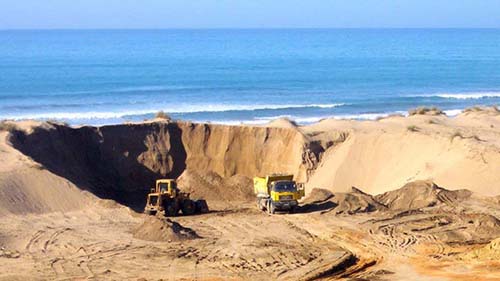
Beach sand is being mined illegally on Morocco's north coast, near Tangier. howstuffworks.com
Introduction
My experience with workshops over the past eight years has always been a joyous one. I have always strived for great accuracy in the items I have made over time, though I would say I only really began to challenge myself to use more complex and varied materials in the last five years. I have worked with fibreglass (GRP), mild carbon steel, Polymorph, and acetal to name a few. This year I had the pleasure to work with woods again and my first time working with ureal in modelling.
My use of machinery was limited before coming to Brunel, and this is the aspect I have acquired most new skills from. A few favourites include the metal lathe for its precision; the band saws for its ability to handle large pieces of work and the polishing machine for its gratifying finish. These machines are the more hands-on approach machinery as they cannot produce an automatic function or process, such as rapid prototyping would do. Whilst I like the thought of how accurate rapid prototyping can be, I prefer to make things with true craftsmanship. In fact, for the Fixperts groups project, we initialised our design in CAD and brought it to life by 3D printing it. Yet, as we had little control over the product when it was being printed, we could not change the outcome. Whereas, when hand-working materials, you can easily counteract a mistake before the product gets to its end stage, i.e. developing as you go.
In terms of how this relates to a material or process I wish to study, it encourages me to adventure avenues such as casting and moulding where you, as the crafter, are involved in the process as well as its outcome. What material comes to mind that is involved in casting? Sand. Sand also has positive properties that make up construction materials such as concrete. The one concern that is seeming to rock our world today: sand is a finite material, and it is running out! Is there a way to replace our dependency on sand so we can still manufacture these important materials that we use in everyday projects? Or are we too little too late?
Material Structure
Sand is a commodity formed from weathered rocks or minerals and fragments of shell left behind by sea-creatures. The colour of the sand is dependent upon the surrounding’s geological conditions; namely what type of rock forms there and how frequent storms are. Thus, they are broken down by waves and the weather over aeons eventually transforming into grains. Moreover, the most common inland conditions produce the infamous constituent of sand, silicon dioxide often found as quartz. Each grain can range in diameter from 0.0625mm to 2mm.
The crystal structure of SiO2 has a tetrahedral arrangement with covalent bonds between one central silicon atom and four oxygen atoms. It can be found in three crystalline forms: quartz, tridymite and cristobalite, each of which of possesses high and low variations. Below is a table that compares these in terms of density and their thermal expansion.
However, silica can be represented as a non-crystalline form too, commonly known as glass (or fused silica). This high purity grade has good dielectric and insulating properties, great for the electronics market. It also has greater tensile strength and a lower density meaning its suitable for such applications like windows. Comparatively, we see quartz have a higher compressive strength, more suitable for concrete where stress will be high.
Industries
Small Scale Manufacture
There are many ways to work with sand but one I particularly find interesting is how one can make metal products by such a manufacturing process called sand casting. It involves the use of a furnace, a pattern of any design, a sand mould and of course, the metal of your choice. The most typical metals to be cast include iron, steel, titanium, aluminium, and various pot metal alloys that may include lead, zinc or tin. The process is undeniably popular as its one of the few available processes that can abstain the high melting temperatures of such metals. In fact, over 70% of all metal castings are produced via this manufacturing method.
Firstly, once a pattern is designed, it can be dug out or impressed into a block of sand between a gating system of two halves. The pattern (if solid and impressed) can then be removed in order to fill the mould cavity with molten metal. This is left to cool, and once solidified, the sand mould can be removed to reveal the casting.
Relatively low tooling costs and a short lead time expands the usability of this method, as one can not only make individual or low volume outputs but equally, high volumes with the addition of automotive parts (for example, the pouring of the molten metal). The castings that can be made are versatile in terms of size, shape, and weight; from ounces to over 200 tonnes. Furthermore, using cores can create internal structures within the desired cast; these can be made from materials such as wood that can be destroyed if necessary to get the cast out. Indeed, there are numerous benefits to sand casting, though the process does not come without its limitations when compared to other casting methods such as die, investment and centrifugal. Sand castings are notorious for having a lower quality surface finish and a lower dimensional accuracy.
The type of sand used is called foundry sand which has unique engineering properties including green, dry, and hot strength (great refractoriness); good permeability; and collapsibility to allow casting to shrink without cracking. Advantageously, modern practice recycles the foundry sand to multiply the number of production cycles and keeping costs at a minimum. Foundry sand is produced at a particle size of less than 75μm and has a silica content of 98%.
Large Scale Manufacture
There are countless industries that use sand in some way, it is unsurprising why so many assume we are in abundance of the material. Silicon dioxide, also phrased as silica, can be altered into many different forms, ranging from an edible powder to gel (fumed) and even glass (fused). A brief list of products that use silica follows:
- Mirrors
- Windows
- Bottles and Jars
- Electronics (both screens and PCBs)
- Paper
- Kitchenware
- Medical Equipment
- Footwear
- Transportation
- Makeup
- Hairspray
- Toothpaste
- Sealants
- Concrete
...the list goes on. Sand is very clearly a beloved material for its versatility, and it shows:
Sand and gravel represent the highest volume of raw material used on Earth after water.United Nations Environment Programme report, 2014.
A shocking fact. Silica is also extracted as a finely-milled powder and used within our dried foods, including soups, salts, spices, instant teas and coffees, to prevent lumps. It is added to grated sliced cheeses to keep each piece separate. To further examine even finer particles, even our plastics contain silica dust! We, as a world, cannot keep rising to such a high demand if our only response is to use our natural, finite resources.
Construction
A particularly sand-dependant product is concrete. Concrete is comprised of Portland cement, sand and gravel, and water, and is used to manufacture bricks, blocks, pipes and building infrastructure. Concrete is also an additive that makes up our roads when combined with bitumen which in turn makes asphalt. This material can also be applied to our pavements. Furthermore, glass has a huge incorporation into the construction industry and is made with molten (or fused) sand at a melting point of 1700°C.
Nearly a decade ago, the construction industry consumed about 11 billion tonnes of sand. It is cited, “extraction rates were highest in the Asia-Pacific region, followed by Europe and North America.” However, today these figures are much harder to find and often misguided, for countries now have an increased intent to hide real extraction rates amid this ‘Sand Race’.
Government agencies state, “official statistics widely underreport sand use and typically do not include non-construction purposes.” Yet, we know that an estimated 95% of all productions of silicon dioxide is used by the construction industry. This leaves us with a detrimental fate and burning question: when will sand run out?
Currently, we use 200 tonnes of aggregate to build an average sized house; making materials including concrete, mortar and facade plaster. A hospital or large premises takes 3000 tonnes to build. More shockingly, it takes 10 times this amount to build just 1km of motorway. Finally, the number increases to a whopping 12million tonnes to build a nuclear plant. Considering there are 440 nuclear plants in operation worldwide, not to mention those that have retired, we most certainly use too much.
The Problem
The current level of political concern clearly does not match the urgency of the situation.United Nations Environment Programme report, 2014.
Our most major problems exist within three ‘deadly’ industries: building material, land reclamation (including beach restoration) and hydrofracking. They are deadly not only due to the fact they are the highest consumers of sand but because they create a loss of islands, lives of the people who gamble in illegal mining, and even destroy full ecosystems. ‘Making’ more natural sand is impossible as it would take billions of years of erosion. Additionally, we cannot use desert sand due to the high and constant winds refining the sand into very fine, spherical grains. Therefore, we mine from beach fronts and quarries.
Environmental
10 years ago, you would go three to five miles offshore, but now we're going as far as 30 miles and further to get that sand and they're having to barge it into the sitesJon Hamilton for NPR, 2007.
The sand race has effectively lead us to dig ourselves deeper, as once these resources went, we turned to dredging. Dredging is the action of suction pumping out mineral sand from ocean floors and river beds. The flaw? Have you ever dug a hole in the sand at the beach with your hand, yet to find the next wave simply wash the surface flat again? This is what is happening on an extraordinary scale! Each time we dredge beneath our waters, we create a void only to be filled by the sands from our beaches – this method has already taken 75-90% of our beach sand and some islands have completely disappeared. The second problem to this is the number of dams we operate around the world. Presently, the figure is approximately 845,000 meaning even if we wanted the sand to retreat to the oceans, it physically can’t, and so, we lose even more resource. Another shameful statistic is that we dredge up 44 billion tonnes of gravel per year versus our dependable finite fossil fuels being <5 billion tonnes of oil and 7.5 billion tonnes of coal.
Unsurprisingly, scientists believe that some countries will be completely rid of available sand by 2020. The top three importers of sand are Singapore with 13% of the worldwide stock, Canada with 11%, and Belgium-Luxembourg with 9%. This is primarily due to the urbanisation boom happening in these countries. On the other hand, the top three exporters of sand are as follows:
| Rank | Country | Natural Sand Exports in 2015 (USD) |
|---|---|---|
| 1 | United States | $385,588,000 |
| 2 | Netherlands | $182,758,000 |
| 3 | Germany | $125,973,000 |
Lives are at significant risk. Local ecosystems can be endangered by the slightest alteration, for instance, the flow direction of a river will change due to the foundations literally being removed. This can, in turn, affect vegetation, particularly dangerous for rural areas dependant upon river flow for growing crops. Additionally, all areas of wildlife will suffer as dredging destroys the living communities on the beds such as coral/marine life, as well as the increase in floating sand particles in the water. An example of this is the Poyang Lake in China which hosts millions of cranes, geese and storks during the cold months – as well as several endangered and rare species [including the freshwater porpoise].
The lack of sand has affected the food chain right up to us humans who now have less fish to find, locals say.
Business
There is reasoning for this sand crisis: demand. But is it greed? Many illegal miners, specifically in India, have emerged to earn a significant profit. The construction sand industry is worth a breath-taking $70billion purely for the fact that we are mining at a much faster rate than what sand is made. A ‘sand mafia’ exists along these coastlines and rivers among another 70 countries worldwide. They work by stealing bags and bags of sand in the dark of the night and it causes more than just a few issues. Firstly, as they consistently take from the same areas, they reduce foundation stability, leading to landslides and even buildings collapsing. In fact, many believe the collapse of a bridge on Savitri River in Mahad, 2016, was caused by such rampant mining. What is worse, for every storm comes more erosion and so repeats the endless cycle.
These issues as a collective affect tourism and agriculture no matter the geographical location – we are all linked to this crisis one way or another.
Alternatives
The question is, can we save the finite resource by replacing our necessity from natural sand to manufactured. There certainly are possibilities but it seems hardly any avenues have been fully explored. The following are either hypothetical solutions or ones where the idea has been initialised but not experimented far enough. Several questions arise from newfound materials. Will it get washed out to sea at the same rate as natural sand? Will it stick to the surf a little more? How quickly will it blend with the sand already there?
M Sand
Also known as Manufactured Sand is specifically engineered for the construction industry as we can derive a certain quality, size, and shape for the replacement of natural aggregate. The substance is crushed hard granite in the form of a cube with rounded edges and is manufactured to be <4.75mm.
As the sand is washed and graded for construction standard, it doesn’t contain impurities such as silt and clay commonly found in riverbed sand; it also does not contain organic compounds thus completely eradicating our need for the natural resource.
However, M Sand can contain micro fibres which can become too large and affect the strength of the concrete. Furthermore, due to its man-made cubical shape, the concrete can sometimes be too stiff which affects workability. Still, a potential upside: if fly ash (a by-product of pulverised coal in the form of a fine powder) is added, the quality is substantially improved.
Downcycling
The wheelie bin recycling industry cannot recycle at least 30% of glass due to it being broken, impure or not a single colour. Considering an average family uses 500 bottles and/or jars a year and recycled glass can be substituted for up to 95% of raw materials, we can preserve over a tonne of natural resources for every tonne of recycled glass. Therefore, a material known as cullet (recycled, broken or waste glass), can be crushed into sand grains to replenish our beaches, rivers, and sand-dependant industries.
Since glass is just molten silica, many of the properties are the same and this method has even been tested in Florida where beach restoration is necessary to keep tourism thriving. Jon Hamilton from NPR news says, “the county has already tested different mixtures of glass and sand on a local beach. The ground-up bottles seem to act just like regular sand, even providing the right environment for loggerhead turtles to lay their eggs.” These turtles previously disappeared from Florida’s coastlines, again wildlife reflecting how we so easily damage our surroundings.
Downcycling could bring many benefits for manufacturers, including a reduction in emissions and consumption of raw materials; an extension in the life of equipment such as furnaces; a conservation of energy – all of which will decrease costs. In fact, the American Glass Packaging Institute stated in 2015, energy costs drop about 2-3% for every 10% of cullet used in the manufacturing process.
Conclsuion
Through this report, I have investigated whether it is possible to save our finite sand resource, and I truly believe it is something we have to push for in the near future because evidently, a world without sand would be devastating. Whilst I think we are relatively far away from a concrete solution, there must be a way and through further research and a fleet of engineers, anything is possible. For the most part, I stand by downcycling as a good method, for now at least. It has a lot of advantages, but any solution severely outweighs sacrificing nature’s sand.
References
- Al Jazeera, 2015. Running Out of Sand: in Numbers. [online article]. Available at: https://www.aljazeera.com/indepth/features/running-sand-numbers-171218092024986.html [Accessed 29 April 2018].
- AZOM, 2001. Silica - Silicon Dioxide (SiO2). [online article]. Available at: https://www.azom.com/article.aspx?ArticleID=1114 [Accessed 29 April 2018].
- BetterChemText, 2009. Quartz and Glass. [online article]. Available at: http://abetterchemtext.com/Condensed/quartz.htm [Accessed 29 April 2018].
- CustomPartNet, 2008. Sand Casting. [online article]. Available at: http://www.custompartnet.com/wu/SandCasting [Accessed 29 April 2018].
- Forkin, D. M., 2015. Is it safe to use M sand instead of river sand in construction of houses? Quora, [Quora answer] 31 October. Available at: https://www.quora.com/Is-it-safe-to-use-M-sand-instead-of-river-sand-in-construction-of-houses [Accessed 30 April 2018].
- Glass Packaging Institute, 2015. Glass Recycling Facts. [online article]. Available at: http://www.gpi.org/recycling/glass-recycling-facts [Accessed 30 April 2018].
- HowStuffWorks. 2019. Sand Is in Such High Demand, People Are Stealing Tons of It | HowStuffWorks. [image and online article] Available at: https://science.howstuffworks.com/environmental/conservation/issues/sand-is-such-high-demand-people-are-stealing-tons-it.htm [Accessed 04 May 2019].
- Jon Hamilton, 2007. Importing Sand, Glass May Help Restore Beaches, NPR Morning Edition. [online podcast] July 2007. Available at: https://www.npr.org/templates/story/story.php?storyId=12026379 [Accessed 30 April 2018].
- Life Noggin, 2018. What Happens If We Run Out of Sand. [online video] Available at: https://www.youtube.com/watch?v=pqBf9Uix-LI [Accessed 29 April 2018]
- Raghunath, P., 2016. Mumbai: Sand mining could have led to collapse of bridge, Gulf News India [online article]. Available at: https://gulfnews.com/news/asia/india/mumbai-sand-mining-could-have-led-to-collapse-of-bridge-1.1874117 [Accessed 30 April 2018].
- Sousa, G., 2017. Top 20 Sand Exporting Countries, World Atlas, [online article]. Available at: https://www.worldatlas.com/articles/top-20-sand-exporting-countries.html [Accessed 29 April 2018].
- TEDx Talks, 2013. Let’s talk about sand: Denis Delestrac at TEDxBarcelona. [online video] Available at: https://www.youtube.com/watch?v=VOXikTyZxPA [Accessed 29 April 2018
- The Conversation, 2017. The World is Facing a Global Sand Crisis. [online article]. Available at: https://theconversation.com/the-world-is-facing-a-global-sand-crisis-83557 [Accessed 29 April 2018].